By FLBayNews Staff
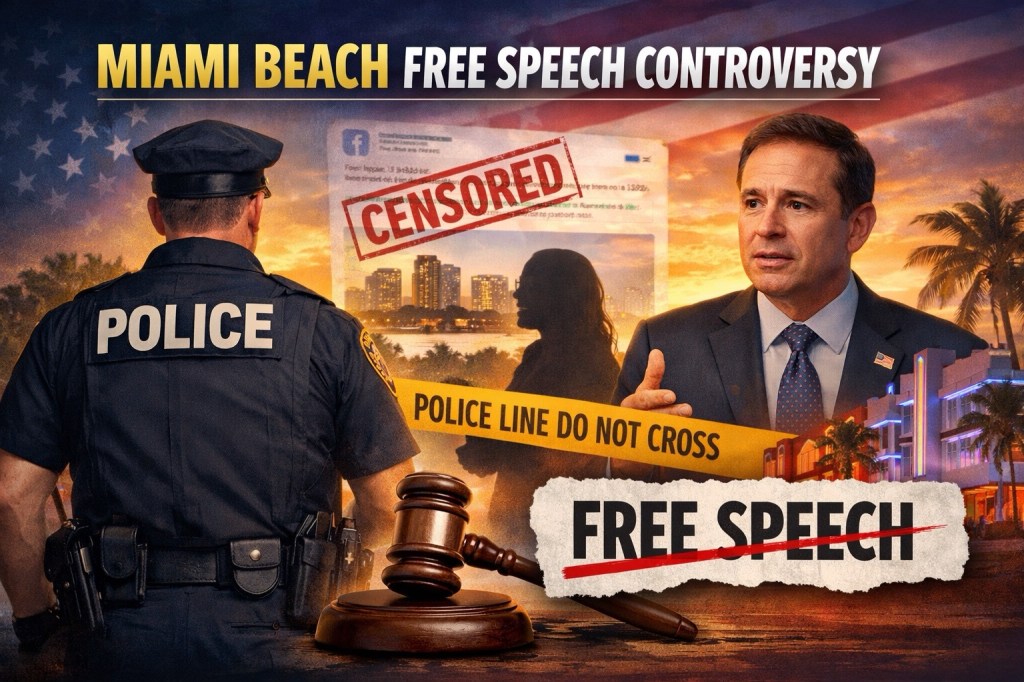
Recent events in Miami Beach should concern every Floridian who believes in the First Amendment. What began as a critical comment on social media quickly escalated into a police visit — not for threats of violence, not for credible danger, but for political criticism directed at the city’s mayor.
On January 7, local activist Raquel Pacheco responded to a Miami Beach mayoral Facebook post with pointed criticism of Mayor Steven Meiner’s positions on Israel and other issues. Days later, detectives from the Miami Beach Police Department knocked on her door to ask about her post. Officers said they were conducting a “voluntary” conversation to ensure there was no threat to public safety.
This episode raises a simple but critical question: When did political speech become a public-safety risk?
Free Speech Isn’t Just for Those We Agree With
The First Amendment protects speech that is unpopular, uncomfortable, or critical of public officials. That is exactly the sort of speech that defines a vibrant democracy. Unfortunately, the perception that criticism equals danger is spreading across our nation — and now, it has surfaced in a city government many assume is on our side of the political spectrum.
Responding to political criticism with police presence — however polite or “voluntary” — sends a chilling message to residents: Think twice before you speak out. And that’s precisely what civil liberties groups have warned about. Critics argue that such encounters can deter ordinary citizens from participating in civic discourse, chilling free expression and undermining trust in government.
Safety or Suppression?
Police Chief Wayne Jones defended the interaction, saying he acted out of concern that inflammatory rhetoric could inspire harm. But that rationale blurs a dangerous line. Law enforcement’s role is to respond to actual threats of violence, not to mediate political disagreements or adjudicate whether a statement is offensive. Using police resources to investigate speech should worry citizens across the political spectrum.
In legal precedent, speech is only unprotected if it’s directed at inciting imminent lawless action — a high bar established in Brandenburg v. Ohio. Mere political criticism, no matter how pointed, does not meet that standard.
A Broader Trend?
This incident didn’t happen in a vacuum. Throughout Florida and across the country, government or semi-government actors have been accused of responding too aggressively to political speech — whether it’s firing state or university employees over social media posts or probing residents for their online opinions. That trend should alarm defenders of constitutional liberties, regardless of their ideological bent.
Public servants should be resilient. Political leaders should expect scrutiny. If officials allow themselves to treat criticism as a security threat, they erode the essential distinction between legitimate law enforcement and political retaliation.
What Comes Next?
Miami Beach residents and elected officials now face a choice. They can reaffirm their commitment to free speech by ensuring that police won’t be used to question critics. Or they can normalize a culture where political expression carries a risk of official pushback.
Floridians — and Americans — must be vigilant. Free speech isn’t just a slogan on a bumper sticker. It’s the foundation of our republic. And a police visit for a Facebook comment crosses a line that should concern us all.
Support Independent Journalism
Florida Bay News is part of the Bay News Media Network — a growing group of independent, reader-supported newsrooms covering government accountability, courts, public safety, and institutional failures across the country.
Support independent journalism that isn’t funded by political parties, corporations, or government agencies
Submit tips or documents securely — if you see something wrong, we want to know
Independent reporting only works when readers stay engaged. Your attention, tips, and support help keep these stories alive.
 Florida Bay News
Leave a comment