By Michael Phillips | FLBayNews
Broward County’s court system has quietly rolled out a significant structural change in how family law cases are handled—one that supporters say could improve accountability, reduce repeat litigation, and better protect children caught in high-conflict disputes.
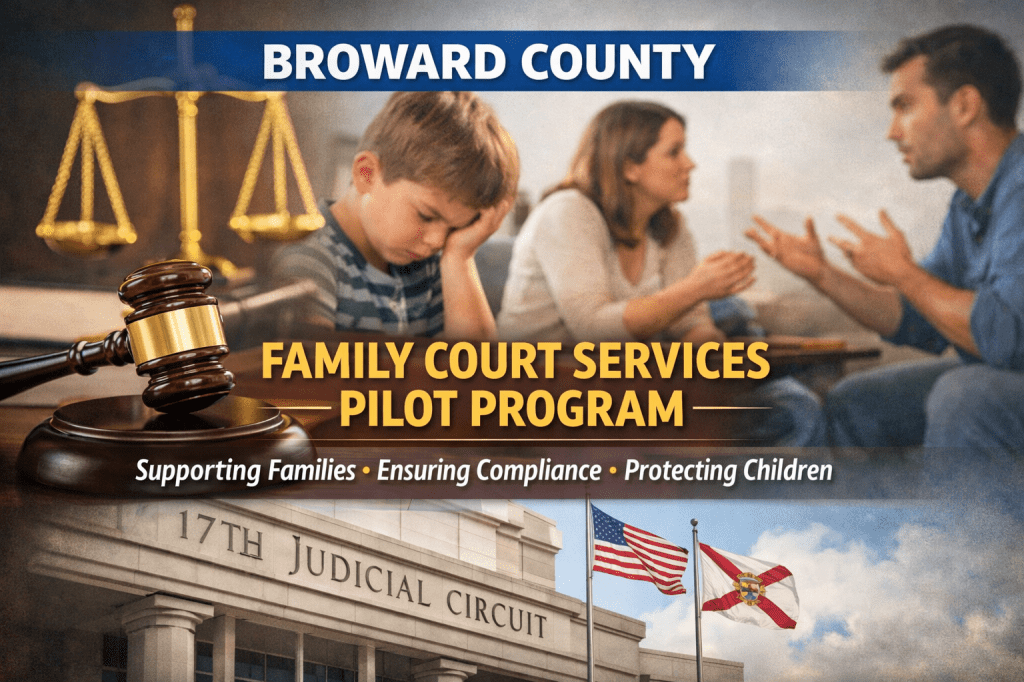
According to a January 9 report from The Florida Bar News, the 17th Judicial Circuit Court has launched a new Family Court Services Pilot Program, a county-funded initiative designed to connect families in crisis with vetted services and ensure court orders are actually followed.
The pilot operates within Broward County’s family courts and serves eight judges and five magistrates handling divorce, custody, and related domestic cases.
Moving Beyond “Band-Aid Justice”
For years, family court judges have faced a familiar problem: issuing orders for counseling, parenting classes, or evaluations without having the staff or infrastructure to ensure those orders were carried out.
Judge Lauren M. Alperstein, one of the program’s architects, described the old approach bluntly.
“We were like a MASH unit putting band aids on these families without any way to really follow through,” she said.
From a center-right perspective, this critique resonates with a long-standing concern about government systems that issue mandates without enforcement or oversight—producing paperwork, not results. The new pilot attempts to close that gap by creating a centralized, in-house unit tasked with follow-through and reporting.
How the Program Works
The Family Court Services unit is housed directly within Court Administration and functions as an operational support arm for judges—not a replacement for the adversarial process, but a supplement focused on compliance and outcomes.
Staff responsibilities include:
- Identifying and vetting community agencies and private providers
- Referring families to court-ordered services such as counseling, parenting classes, substance abuse treatment, and social investigations
- Monitoring whether parties actually attend and comply with ordered services
- Reporting compliance back to the court
In effect, the unit serves as the “eyes and ears” of the court—an accountability function that has long been missing in many family law systems.
Defined Roles, Defined Responsibility
Unlike loosely structured referral systems, the pilot assigns clear roles:
- Family Court Services Manager: Oversees and vets service providers (a role filled by Diane St. Amand-Scott)
- Judicial Navigator: Handles complex cases and service coordination
- Judicial Support Investigator: Provides evaluative information for custody and visitation disputes
- Administrative Assistant: Supports daily operations
This kind of role clarity aligns with conservative governance principles: defined authority, limited mission creep, and measurable outputs.
Therapeutic Justice—With Guardrails
The program is rooted in the concept of therapeutic justice, an approach endorsed by the Florida Supreme Court that emphasizes reducing conflict and addressing underlying issues—especially when children are involved.
Supporters argue that when used carefully, therapeutic justice can complement due process rather than undermine it by:
- Improving compliance with lawful court orders
- Reducing repeat filings and prolonged litigation
- Encouraging stability for children instead of endless procedural churn
Chief Judge Carol-Lisa Phillips called the pilot “a big positive,” while Trial Court Administrator Joe D’Amico credited Broward County for funding the effort after months of internal collaboration.
Why This Matters
Family courts are among the most resource-strained and emotionally charged parts of the justice system. When orders are issued without enforcement, the result is often:
- Increased conflict
- Repeat court appearances
- Higher costs for taxpayers and families alike
- Greater harm to children
This pilot does not expand judicial power or create new mandates. Instead, it attempts to make existing orders meaningful—a goal that should appeal across ideological lines.
Whether the program succeeds will depend on execution, transparency, and restraint. But if it delivers on its promise—fewer repeat cases, better compliance, and reduced harm to children—it could serve as a model for other Florida jurisdictions looking to make family courts more effective without growing government for its own sake.
For now, Broward County is testing a simple premise: courts work better when orders are followed, not forgotten.
Support Independent Journalism
Florida Bay News is part of the Bay News Media Network — a growing group of independent, reader-supported newsrooms covering government accountability, courts, public safety, and institutional failures across the country.
Support independent journalism that isn’t funded by political parties, corporations, or government agencies
Submit tips or documents securely — if you see something wrong, we want to know
Independent reporting only works when readers stay engaged. Your attention, tips, and support help keep these stories alive.
 Florida Bay News
Leave a comment