By Michael Phillips | FLBayNews
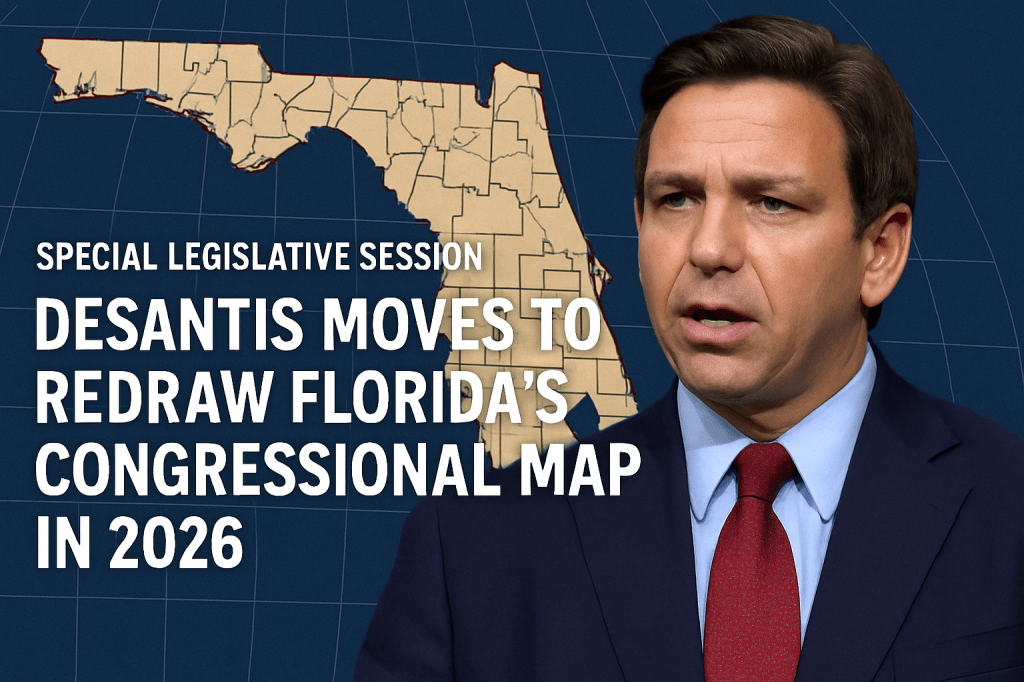
Gov. Ron DeSantis confirmed this week that he will call a special legislative session in early 2026 to redraw Florida’s congressional districts ahead of the midterms—a rare mid-decade move with potentially major national consequences. If successful, Republicans could gain as many as five to six new U.S. House seats, reshaping Florida’s political landscape and countering the Democratic gains expected from California’s own mid-decade redistricting.
The session is expected to take place in March or April 2026, after the U.S. Supreme Court rules on a major Voting Rights Act (VRA) Section 2 case that could redefine the legal boundaries for race-based redistricting nationwide.
A Brief Look Back: Florida’s Current Map
Florida last redrew its congressional lines after the 2020 census. That fight was contentious: DeSantis vetoed the Legislature’s Republican-backed map and demanded his own, eventually pushing through a version that expanded GOP control from 16 seats to 20 out of 28.
The 2022 map has faced continuous legal challenges—particularly around the dismantling of a protected Black district in North Florida—but the Florida Supreme Court upheld it in July 2025, clearing GOP lawmakers to pursue a new map without court-ordered constraints.
Redistricting normally occurs once per decade, but Florida law does not prohibit mid-cycle redraws. DeSantis has repeatedly argued that Florida was “shortchanged” in 2020 apportionment, gaining only one new seat despite explosive population growth.
The 2026 Special Session: What’s Driving It
DeSantis’s December 1 announcement was not a surprise. The signs have been building for months:
- The Florida House created a Select Committee on Congressional Redistricting in November, with its first hearing scheduled for December 4.
- DeSantis told reporters to “Stay tuned” when Speaker Daniel Perez downplayed early redistricting rumors.
- Senate Majority Leader Ben Albritton has been coordinating with DeSantis on timing, with both waiting for the Supreme Court’s upcoming VRA decision.
Behind the scenes, the effort is part of a national Republican strategy pushed by President-elect Donald Trump to lock in a more durable House majority heading into 2026. Republicans currently hold the House by a narrow 220–215 margin.
Florida is expected to play an outsized role.
The California Factor: Why Republicans Call This a “Counterpunch”
California voters approved Proposition 50 in November 2025, authorizing a mid-decade redraw that Democrats hope will consolidate urban areas, unwind GOP-friendly districts, and potentially gain up to five new Democratic seats.
National Republicans quickly called Florida’s move a necessary counterweight.
In conservative circles online, activists framed DeSantis’s announcement as “cancelling out Newsom’s gains”—an acknowledgment that the redistricting wars have escalated into a state-by-state partisan arms race.
Could Republicans Really Gain 5–6 Seats?
GOP strategists circulating mock maps on X argue that Florida’s map could shift from 20R–8D to 25R–3D or even 26R–2D.
Democratic districts seen as most vulnerable include:
- FL-10 (Maxwell Frost – Orlando)
- FL-14 (Kathy Castor – Tampa)
- FL-22 (Lois Frankel – Palm Beach)
- FL-23 (Jared Moskowitz – Broward)
- FL-25 (Debbie Wasserman Schultz – Miami-Dade)
The only reliably safe Democratic seats under even the most aggressive GOP scenarios:
- FL-9 (Darren Soto)
- FL-20 (Sheila Cherfilus-McCormick)
- FL-24 (Frederica Wilson)
Why those three?
Each is anchored in heavily minority, urban districts where even a creative redraw cannot realistically eliminate the Democratic base.
Still, the predicted gains depend on:
- how aggressively the Legislature draws South Florida
- whether the courts intervene
- whether the Supreme Court ruling alters race-based districting requirements
- whether population equalization forces ripple effects statewide
In other words: the path to a 5–6 seat GOP advantage exists, but it is not guaranteed.
Political Reactions
Republicans: Full Steam Ahead
Florida Republicans—along with national Trump-aligned influencers—are celebrating the move as a decisive strategic step. Many view it as an assertion of DeSantis’s authority over more cautious figures such as House Speaker Daniel Perez, who had previously signaled reluctance.
Trump advisers have framed Florida’s redraw as critical to preventing Democratic gains and “locking in” a House majority.
Democrats: This Is Gerrymandering 2.0
Democratic leaders immediately blasted the announcement as an “abuse of power” meant to dilute minority voting strength and bypass the Fair Districts constitutional amendments passed by Florida voters.
They argue a mid-decade redraw violates the spirit, if not the letter, of the amendments meant to prevent partisan gerrymandering.
Lawsuits are guaranteed.
Legal Analysts: Prepare for a Court Fight
Several factors could trigger litigation:
- racial vote dilution claims under Section 2 of the VRA
- partisan fairness challenges under Florida’s constitution
- whether a mid-decade redraw is “necessary” or solely political
Depending on the timing, litigation could push the final map into late summer 2026, potentially affecting candidate filing deadlines and primary dates.
What Comes Next
The process begins in earnest at the December 4 committee hearing. From there:
- Draft maps may appear as early as January 2026.
- The Supreme Court’s VRA decision—expected by March—will shape the legal environment.
- The special session will convene in March or April, where the Legislature could pass a map within days.
- Court challenges could follow immediately.
If the map survives legal review, Florida could become the defining battleground of the 2026 midterms.
Bottom Line
Florida’s mid-decade redistricting push is one of the most consequential political maneuvers in the country heading into 2026. If Republicans can redraw the map without judicial intervention, the party could net half a dozen new seats—more than enough to offset California’s Democratic gains and secure national control of the U.S. House.
If the courts step in, the political calculus changes dramatically.
Either way, Florida is about to become the center of the redistricting war.
 Florida Bay News
Leave a comment